
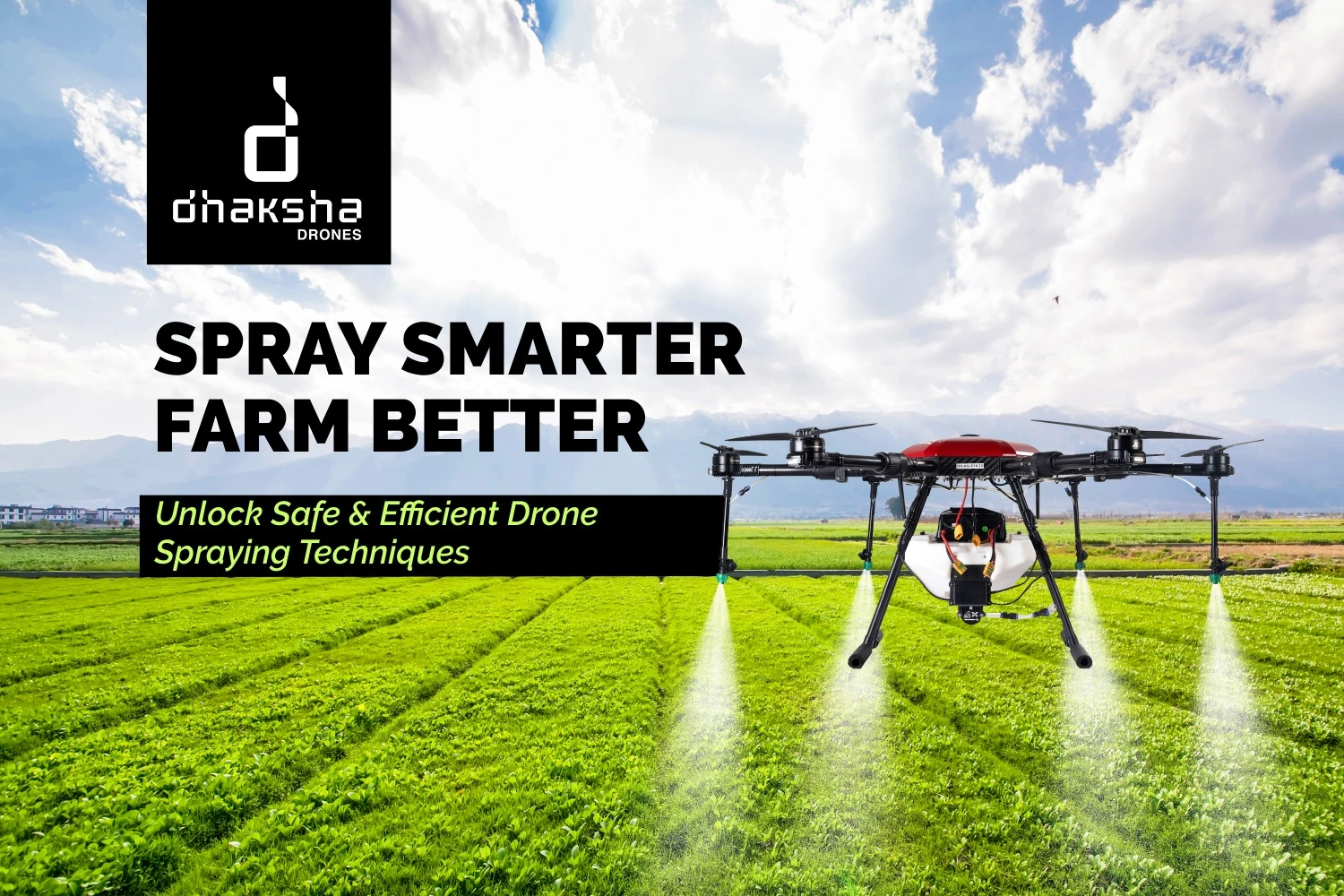
Agricultural drone spraying best practices are now the foundation of modern precision farming in India. With over 15 lakh farmers exploring drone technology for crop protection, and the Indian agri-drone market projected to grow at 35% CAGR through 2030, the difference between success and failure in this sector comes down to one thing: how well you spray.
Poor spraying technique leads to crop damage, chemical wastage, environmental harm, and DGCA penalties. The Indian Council of Agricultural Research (ICAR) reports that improper drone spraying can reduce pesticide effectiveness by up to 40% while increasing environmental contamination, a costly outcome in densely farmed rural landscapes.
This comprehensive guide, written by the Dhaksha Drones technical team, covers every critical dimension of safe and efficient agricultural drone spraying, from DGCA compliance and pre-flight planning to nozzle selection, drift prevention, and government subsidies available in 2025. Whether you are operating in the paddy belts of Tamil Nadu or the cotton fields of Maharashtra, these best practices will help you achieve superior results while protecting your investment and the environment.
Precision drone spraying reduces pesticide consumption by 30–50% and water usage by up to 90% versus manual methods. (Source: ICAR 2024)
Why Safe Drone Spraying Practices Matter in India
India’s diverse agro-climatic landscape presents unique challenges that make adherence to safe drone spraying guidelines non-negotiable. Unlike conventional spraying methods, agricultural drones operate in three-dimensional airspace, requiring operators to understand aerodynamics, weather patterns, and chemical behaviour simultaneously.
The Environmental and Economic Stakes
Unsafe agricultural drone spraying practices can result in:
- Spray drift contaminating neighbouring farms, water bodies, and residential areas
- Uneven chemical distribution leading to pest resistance , a serious long-term threat
- Damage to pollinators and beneficial insects critical to Indian crop yields
- DGCA violations resulting in fines and operational suspension
- Equipment damage and costly emergency repairs
- Health hazards to operators from agrochemical exposure
Following agri drone spraying best practices in India is not just about regulatory compliance; it is about protecting crops, communities, and your business reputation in an emerging sector where trust is still being built.
1. DGCA Compliance , The Non-Negotiable Foundation
Every commercial agricultural drone operator in India must hold a Remote Pilot Certificate (RPC) from a DGCA-approved RPTO, register the drone on the Digital Sky platform with a valid UIN, and fly only in designated Green or Yellow zones. All aerial applications must use CIB&RC-approved chemicals only, no exceptions. Operating without certification carries penalties up to Rs 1 lakh and potential imprisonment under Indian aviation law.
Most farmland across India falls within Green Zones (flights up to 400 ft without prior permission). Always verify on the Digital Sky Map before each operation. Flight logs are mandatory and subject to DGCA audit , log date, GPS coordinates, chemical name, dosage, area, and weather conditions after every mission.
Airspace Zones: Green, Yellow, and Red
Green Zones: No prior permission required for flights up to 400 feet. Most farmland across India falls within Green Zones. Yellow Zones: Permission required from ATC or Air Defence. Red Zones: Strictly prohibited. Always verify on the Digital Sky Map before each operation.
Dhaksha Drones operates a DGCA-approved RPTO in Chennai. Buy your drone and get DGCA-certified in one place , no third-party training centre, no scheduling delays.
2. Pre-Flight Planning , 15 Minutes That Prevent Hours of Problems
Successful precision agriculture drone spraying begins long before the drone takes flight. Operators who invest 15–20 minutes in thorough pre-flight preparation consistently achieve 25–30% better spray coverage and significantly lower chemical wastage than those who skip this phase.
Never skip the pre-flight phase. Before every mission, confirm:
- Battery levels, nozzle condition, tank seal integrity, and GPS lock (minimum 12 satellites)
- Wind speed 3–10 km/h, temperature 18–28°C, humidity above 50%, no rain within 4 hours
- Field mapped for power lines, trees, water bodies, and residential boundaries
- Neighbouring farmers notified; no livestock or people in the spray zone
- Chemical dilution calculated for target pest, crop stage, and label rate
Schedule operations in the early morning (6–10 AM) or late evening (4–7 PM) , India’s peak-afternoon heat accelerates droplet evaporation and reduces efficacy significantly.
3. Optimal Flight Parameters by Indian Crop Type
Flight altitude and speed are the two most impactful parameters for spray efficiency. The table below is the first crop-specific flight parameter reference built for Indian farming conditions:
| Crop | Speed | Altitude | India-Specific Notes |
| Paddy / Rice | 3–5 m/s | 2–3 m | Slow speed for canopy penetration; coarse droplets preferred |
| Sugarcane | 4–6 m/s | 3–4 m | Increase altitude slightly to clear tall top growth |
| Cotton | 4–5 m/s | 2–3 m | Watch boundaries; medium droplets to limit drift |
| Wheat / Pulses | 5–7 m/s | 2–3 m | Open canopy; faster coverage without efficacy loss |
| Vegetables | 2–4 m/s | 1.5–2 m | Reduce rotor downwash; low speed prevents leaf damage |
Maintain a 10–15% swath overlap between adjacent passes to eliminate invisible coverage gaps. Calibrate swath width using water-sensitive paper before the first run on any new field.
4. Nozzle Selection and Drift Prevention
Nozzle selection is the most under-estimated factor in spray quality. For paddy and sugarcane , India’s two largest drone-spraying crops , use medium to coarse droplets (250–450 µm). Fine droplets evaporate in high-temperature paddy environments before reaching lower leaf layers where stem borers reside.
To prevent spray drift , the single biggest cause of off-target contamination:
- Fly at minimum safe altitude for the crop (see table above)
- Always spray with wind direction, never crosswind
- Maintain 15–30 metre buffer zones around water bodies, organic farms, and residences
- Reduce nozzle pressure to avoid atomising droplets into fine, drift-prone sizes
- Monitor wind direction throughout the operation, not just at the start
5. Chemical Safety and Post-Flight Maintenance
Wear nitrile gloves, N95 mask, goggles, and a chemical-resistant apron during tank loading. Triple-rinse the tank between every chemical change. After every mission: flush nozzles with clean water for 2 minutes, inspect propellers for micro-cracks or corrosion, update the flight log, and record battery cycle counts. Schedule a full preventive maintenance inspection every 50 flight hours to protect your investment and maintain DGCA compliance.
6. Government Subsidies Available
India’s central and state governments are actively funding agri-drone adoption. Key schemes currently active:
| Scheme | Eligible Beneficiary | Subsidy Value | How to Apply |
| Namo Drone Didi | Women SHGs | Up to 80% (max Rs 8 lakh) | Ministry of Rural Development |
| SMAM Scheme | Individual Farmers / FPOs | 40–50% on purchase | agrimachinery.nic.in |
| Agriculture Infrastructure Fund | Cooperatives / Agri-startups | 3% interest subvention | State Nodal Banks |
| Tamil Nadu Scheme | Organic farmers (TN) | 100% free training | TN Agri Dept Portal |
| Maharashtra Add-on | FPOs (MH) | Extra Rs 1 lakh | MH Agriculture Dept |
- Namo Drone Didi: Up to 80% subsidy (max Rs 8 lakh) for Women Self-Help Groups , apply via Ministry of Rural Development
- SMAM Scheme: 40–50% subsidy for individual farmers and FPOs , apply at agrimachinery.nic.in
- Tamil Nadu: 100% free drone training for organic farmers via TN Agriculture Department
- Maharashtra FPO add-on: Extra Rs 1 lakh subsidy on SMAM-eligible drone purchases
Subsidy disbursements are via Direct Benefit Transfer after physical drone inspection by an agriculture officer.
7. Why the Dhaksha Agrigator Is Built for Indian Conditions
Not all agricultural drones are equal , and most available in India were designed for different farming contexts entirely. The Dhaksha Agrigator series was engineered from the ground up for India’s specific agro-climatic conditions, field sizes, and operator profiles.
Dhaksha Agrigator E10 , Key Specifications
- 10-litre precision spray tank (covers approximately 2 acres per charge)
- RTL (Return-to-Launch) on low battery, communication failure, and empty tank , critical safety failsafe
- Terrain-following capability up to 50 metres AGL
- GPS-guided autonomous mission planning
- IP56-rated for dust and chemical splash resistance
- DGCA type-certified , fully compliant with Indian regulations
DH-AG-H1 , India’s Only IC Engine Medium Category Agri Drone
- 12-litre spray tank with high-precision nozzle system
- 35-minute flight endurance , ideal for larger plantation operations
- IC engine propulsion for extended range without battery logistics
- Designed for large-scale paddy, sugarcane, and plantation crop applications
When evaluating which drone is best for paddy spraying in India, consider not just specifications but after-sales support quality, training availability, and how deeply the manufacturer understands local crop protection challenges. The Agrigator’s design incorporates direct feedback from thousands of Indian farmers across Tamil Nadu, Maharashtra, Punjab, and Telangana , resulting in practical solutions for real-world conditions, not laboratory benchmarks.
Conclusion
Safe and efficient agricultural drone spraying in India depends on four fundamentals: DGCA compliance, disciplined pre-flight planning, correctly calibrated flight parameters, and a drone built for Indian field conditions. Operators who master these practices consistently achieve 30–50% lower input costs and meaningfully better pest control outcomes. The technology is proven , the difference now is purely in how well you use it.
Frequently Asked Questions
Q1: What is the best altitude for drone spraying in India?
For most Indian field crops, 2–4 metres (6–13 feet) above the crop canopy is the recommended altitude. For dense crops like paddy and sugarcane, maintain 2–2.5 metres for better penetration into the lower canopy layers. For row crops with wider spacing, 3–4 metres works effectively. Flying lower improves coverage but risks rotor downwash damaging crops; flying higher increases spray drift.
Q2: Can agricultural drones reduce pesticide use in farming?
Yes, significantly. Precision drone spraying reduces pesticide consumption by 30–50% compared to traditional methods through targeted application, reduced drift, and optimal canopy penetration from rotor downwash. This reduction directly improves farm economics and reduces environmental burden.
Q3: Which drone is best for paddy spraying in India?
The best paddy-spraying drone should have a 10–16 litre tank, 2–4 metre altitude capability, GPS-guided autonomous operation, corrosion-resistant components for wet paddy conditions, and terrain following for India’s uneven bunds. The Dhaksha Agrigator E10 and DH-AG-H1 are designed specifically for Indian conditions, including paddy, with DGCA certification and integrated RPTO training support.