
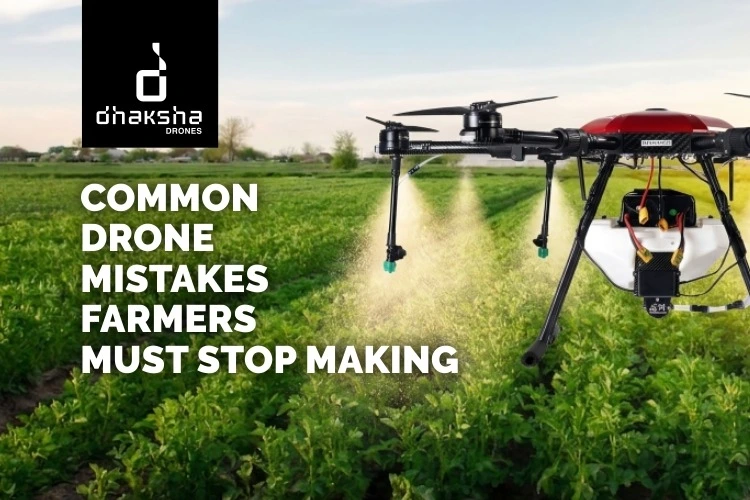
Introduction to Agricultural Drone Spraying
Agricultural drones are rapidly transforming Indian farming by enabling precision spraying, reducing labour costs, and improving efficiency. But simply owning or using a drone is not enough. Many farmers fail to achieve expected results due to improper usage.
To ensure safe and efficient agricultural drone spraying, it is important to understand where things usually go wrong and how to fix them.
1. Ignoring Pre-Flight Checks
One of the most common mistakes is skipping pre-flight inspections. This may seem like a small step, but it can lead to serious operational issues.
When drones are not checked properly:
- Batteries may fail mid-flight
- Nozzles may be clogged, leading to uneven spraying
- GPS errors can cause poor navigation
At Dhaksha Drones, we always recommend a simple habit – never fly without inspection.
To avoid this mistake:
- Check battery health and charge level
- Inspect nozzles and spray system
- Ensure GPS and sensors are working correctly
- Tighten propellers and check for damage
2. Incorrect Spray Height and Speed
Another frequent issue is flying too high or too fast. While it may save time, it reduces spraying accuracy.
This leads to:
- Poor crop coverage
- Chemical drift to nearby areas
- Increased pesticide wastage
For better results:
- Maintain a height of around 1.5 to 3 metres (depending on crop type)
- Adjust speed based on crop density
- Monitor spray pattern during operation
Using the right parameters is key to precision farming, something Dhaksha Drones strongly emphasises in all operations.
3. Poor Flight Planning
Many farmers still rely on manual flying instead of using automated flight paths. This creates inefficiencies across the field.
Common problems include:
- Overlapping spray areas
- Missed sections of crops
- Higher operational costs
A smarter approach is:
- Use GPS-based field mapping
- Plan routes before spraying
- Follow structured grid patterns
With proper planning, farmers can achieve uniform spraying and save both time and resources.
4. Incorrect Use of Chemicals
Using too much pesticide or mixing it incorrectly is a serious mistake. While drones are designed to reduce chemical usage, wrong practices can cause the opposite effect.
This can result in:
- Crop damage
- Soil health issues
- Increased farming costs
To avoid this:
- Always follow recommended dosage
- Use properly calibrated spray systems
- Avoid mixing incompatible chemicals
Dhaksha Drones promotes responsible and precise spraying to maximise efficiency while protecting crop health.
5. Ignoring Weather Conditions
Weather conditions play a major role in spray effectiveness, yet many farmers overlook this factor.
Spraying in the wrong conditions can cause:
- Drift due to strong winds
- Reduced absorption due to high temperatures
For better results:
- Spray early morning or late evening
- Avoid spraying during strong winds
- Monitor local weather conditions before operation
6. Lack of Proper Training
Operating an agricultural drone requires skill and technical understanding. Untrained usage often leads to poor results and safety risks.
Common challenges faced by untrained operators:
- Incorrect flight control
- Poor spray calibration
- Risk of accidents
The best approach is:
- Get proper drone operation training
- Work with certified professionals
- Follow standard operating procedures
Dhaksha Drones actively supports training and awareness to ensure safe adoption of drone technology in India.
7. Lack of Regular Maintenance
Many farmers use drones continuously without proper maintenance, which affects performance over time.
This leads to:
- Blocked or damaged nozzles
- Reduced spray efficiency
- Shorter drone lifespan
To maintain performance:
- Clean the spray system after every use
- Inspect components regularly
- Schedule periodic servicing
8. Mismanagement of Battery and Payload
Battery and payload management is often underestimated, but it directly impacts productivity.
Poor handling can cause:
- Reduced flight time
- Incomplete field coverage
- Frequent interruptions
To improve efficiency:
- Plan operations based on battery capacity
- Avoid overloading the drone
- Keep backup batteries ready
Best Practices for Safe and Efficient Drone Spraying
To get the best results from agricultural drones, farmers should combine the right knowledge with the right technology.
Key practices include:
- Using precision farming techniques
- Maintaining correct spray parameters
- Following standard operating procedures
- Ensuring trained operation
- Performing regular maintenance
With proper usage, drones can:
- Reduce pesticide usage significantly
- Save water and labour costs
- Improve crop yield and quality
- Minimise environmental impact
At Dhaksha Drones, the focus is not just on technology, but on helping farmers achieve real, measurable results.
FAQs
Are agricultural drones safe for spraying pesticides
Yes, when used correctly, they reduce human exposure and ensure precise application.
How much area can a drone cover in a day
Drones can typically cover 30 to 150 hectares per day depending on the model and field conditions.
Do drones reduce pesticide usage
Yes, precision spraying can significantly reduce pesticide usage when done properly.
Is training necessary to operate agricultural drones in India
Yes, training is important for safe, efficient, and compliant operations.
What is the most common mistake farmers make with drones
Improper calibration and poor flight planning, which lead to uneven spraying and wastage.
Trusted Source Links
mdpi
frontiersin.org